

Published:
Updated:
What Career Opportunities Are Available With an A&P Certification?
TL;DR: An A&P certification is an FAA license for aircraft maintenance. It unlocks diverse career paths in both aviation and non-aviation sectors. This certification can offer long-term career stability and good earning potential, and is obtainable through FAA-approved training and exams.
Making a career change or finding your ideal occupation can be challenging. However, the opportunity to earn a steady income in a vocation that offers long-term stability is important. This leads to a difficult choice when considering a technical career. There's a need to find a fully qualified course and a desire for a wide range of career choices once qualified.
Training for an A&P (Airframe and Powerplant) certification gives learners significant career opportunities in the aviation industry. Additionally, there are other industry options available with an A&P qualification. Being qualified under the strict standards of A&P training provides a federally approved certificate without having to spend four years obtaining it.
This guide by A&P Mechanic Institute elaborates on the aviation-focused careers this qualification opens doors to. It also explains which non-aviation careers you can consider.
What Is an A&P Certification and What Does It Cover?
An A&P certification is a Federal Aviation Administration (FAA) license. Airframe (A) covers areas such as structures, systems, electronics, rotors and anything that's not connected to the engines. Powerplant (P) covers the engines, both jet and reciprocating, including propellers.
An A&P qualification is essential for legally certifying aircraft as airworthy. The ability to sign off on aircraft maintenance can lead to careers in several fields, including aviation. An airframe and powerplant license typically covers the following areas:
Working on aircraft of all sizes and types, or other industries that need mechanical support
Conducting major repairs and inspections, both scheduled and unscheduled
Signing logbooks to officially certify aircraft quality and airworthiness
Making sure that aircraft meet FAA safety standards
As federally regulated and certified individuals, A&P-qualified professionals have the authority to approve an aircraft for return to service. The skills an A&P study provides are considered universal mechanical principles, such as pneumatics, hydraulics, electrical systems and more.
Aviation-Focused Careers
It's important to know the breadth and depth of an aviation-focused career. A career in aviation is more than just fixing planes at a gate. The career paths available with A&P certification extend to a wide range of challenges, industries and travel opportunities.
Below are some of the areas and industries:
Commercial Aviation (Airlines)
Commercial passenger airlines continue to recruit talent. A&P-certified skills can transfer to major airlines like Delta, United Airlines, American and even smaller regional carriers. The commercial airline industry offers regular work and a stable career opportunity, due to the year-round high volume of cargo and passengers.
The timely arrival and departure of commercial planes indicate that strong maintenance operations teams are in place. There's also the opportunity to travel and gain employee flight benefits. It's also an industry that continues to grow. Boeing's most recent commercial market outlook summary recorded over 2 million new personnel hires worldwide.
Cargo and Logistics
As a core part of modern trading, the cargo and logistics industry continues to grow. Its global market size is $14.1 trillion. The rise in e-commerce and faster delivery expectations has also driven a need for dedicated fleet maintenance teams. Cargo plane giants like FedEx and UPS are potential places to pursue a career.
Executive Aviation
Executive travel is a popular choice for corporations. Private terminals and smaller aircraft can help business representatives make direct, personalized trips to attend meetings or site visits. These private business aircraft require maintenance and repairs just like larger aircraft. A&P certification may also lead to a potential career with exclusive, high-class travel opportunities with notable clientele.
Agricultural Aviation
Aerial agricultural applicators are used across all 50 states in the U.S. The industry treats over 127 million acres of cropland each year. As the industry continues to move toward technical solutions, the need for maintenance and technical support is likely to increase.
The day-to-day aspects of a career in agricultural aviation will include:
Repairing, inspecting and making any necessary modifications to aircraft.
Daily maintenance checks (electrical, pneumatic and hydraulic) on sprayer and spreader equipment.
Work schedules that fit around farming seasons — expect longer days in the summer months due to increased aircraft use.
A combination of working with your hands and referring to technical manuals to ensure software and GPS systems are up to date.
People with an airframe and powerplant license should consider this industry if they enjoy working directly on airfields or hangars. A passion for computer-aided design (CAD) innovations and chemical agricultural systems will also be beneficial.
Aerospace and Defense
Aviation-focused careers in aerospace and defense will predominantly lead to contractor or government roles. These maintenance and technical roles may require qualified employees to work on cutting-edge projects that require security clearance.
The aerospace and defense industry is growing faster than average. It's projected to grow by 6% over the next 10 years, according to the U.S. Bureau of Labor Statistics. This breaks down to around 4,500 job openings each year. Engineers looking to increase credibility in this industry may also consider gaining an A&P certification to develop maintenance and structural integrity knowledge.
Rotorcraft (Helicopters)
A&P certification can also qualify individuals to perform maintenance and repair on helicopters, which can require more maintenance than their fixed-wing counterparts. Helicopters provide a vital component of the medical transportation network, and the U.S. has the largest fleet of helicopters used for this type of transport.
The global helicopter market is currently estimated at $48.2 billion. It presents a unique opportunity to explore new career paths, such as medical transportation, local and national news outlets and law enforcement.
Non-Aviation Careers
Technical advancements in sectors beyond aviation continue to grow, as well. For people exploring careers available with A&P certification, there's an opportunity to excel in many different areas. Some of the most promising non-aviation careers to consider are:
Amusement and Theme Parks
Amusement and theme parks rely on hydraulic and pneumatic systems similar to those used in aircraft landing gear. The complicated thematic landscapes of these theme parks require skilled maintenance teams. Globally renowned parks like Disneyland and Universal need to adhere to strict safety inspections, just like airlines.
Many non-aviation careers like this still need to hire people with A&P certification. It demonstrates a dedication to preserving the rides and to the safety of all attendees.
Energy and Power Generation
Renewable energy is a very promising industry. The market is anticipated to reach over $2 trillion by 2030. This presents a unique career opportunity for anyone looking to obtain an A&P certification. An airframe and powerplant license can bring several transferable skills to this industry, including:
Safety and compliance: A&P graduates are trained to adhere to the strictest of regulatory compliance standards. This is an integral part of ensuring safe practices in hazardous project environments.
Turbine and engine skills: The skills gained from studying aircraft engines can be applied to how power plants use gas turbines to generate power.
Intelligent troubleshooting: An A&P certificate develops the ability to read complex technical manuals and follow intricate instructions to repair and sign off on equipment.
Structural inspection and repair: An A&P mechanic with experience in composite repairs can be in high demand for power generation projects that require wind turbine blade inspections and repairs.
Hydraulics and pneumatics: The skills gained through aircraft electrical systems training are directly transferable to oil and gas drilling and hydraulic systems in wind turbines.
Electrical maintenance skills related to solar repairs, battery storage and wind turbine generators are also key transferable factors.
High-Speed Rail and Transit
Rail and transit systems are the backbone of an efficient economy. As high-speed rail development programs continue, job vacancies are likely not far behind. The combination of precision and high-speed equipment that modern rail services provide will need skilled maintenance teams.
An airframe and powerplant license requires complex electrical and hydraulic maintenance knowledge, which is integral to a successful career in rail and transit.
Automotive Racing
A&P training provides intricate, detailed knowledge of how mechanics and hydraulics function. In the racing industry, this knowledge applies to vehicles that perform at a world-class level. NASCAR, Formula One (F1) and other motor racing sports rely on mechanics and maintenance teams to ensure success.
The avenues available for A&P-qualified people in the racing industry can vary. They'll typically include exercising skills in the following areas:
Specialized welding
Checking carbon fiber bodywork
Finely tuning racing engines
Conducting repairs under time-sensitive conditions
Being qualified in A&P isn't an essential requirement in all automotive areas. However, it does offer more opportunities across a wider range of specialisms.
A&P Certification and Long-Term Career Stability
It's rare to find a job with long-term career stability these days, but the global demand for maintenance technicians is considerable. It's predicted that over 710,000 new maintenance technicians will be needed to meet this demand over the next 20 years.
Unlike other industries, technical maintenance careers remain strong during recessions. Aircraft still have to fly, and people still need to travel safely in times of economic uncertainty. A&P-certified employees can also earn a potential median annual salary of $79,140.
How to Get A&P Certification
The FAA's A&P certification process takes time and effort. However, the specific timeline will depend on several factors.
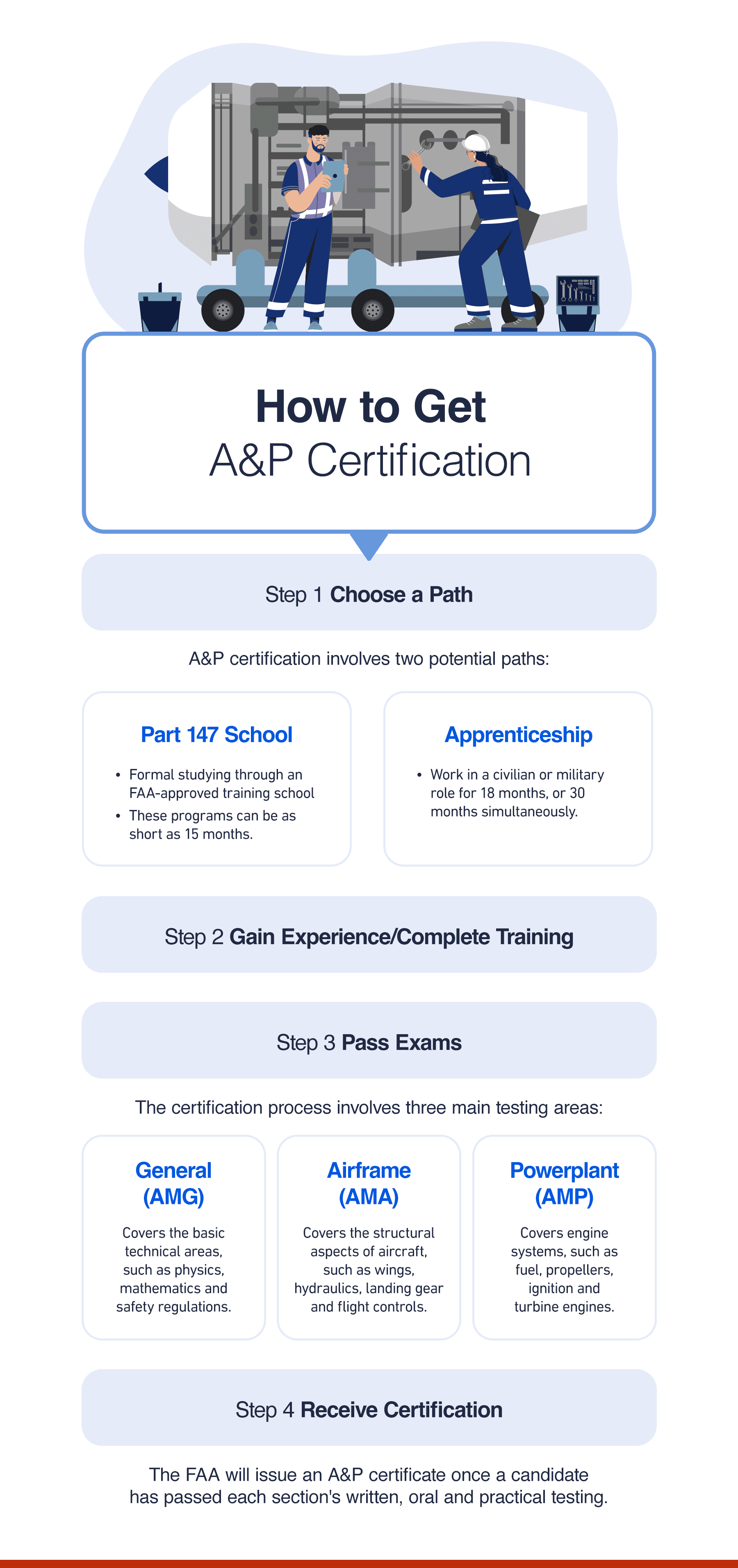
A&P certification involves two potential paths. Both of the options below end with a certificate of completion, which allows the exams to be taken:
Part 147 school: Formal studying through an FAA-approved training school helps prepare you for the written, oral and practical exams needed to qualify. The detailed, structured curriculum covers all topics through a fast-tracked learning plan. These programs can sometimes be as short as 15 months.
Apprenticeship: This approach requires candidates to work in a civilian or military role. Experience is gained by working on an airframe or powerplant for 18 months, or 30 months simultaneously. Detailed task logs must be maintained under the supervision of a licensed mechanic.
The certification process involves three main testing areas to challenge the knowledge and skills gained. These segmented areas are general, airframe and powerplant. Each area requires a written, oral and practical exam:
General (AMG): Covers the basic technical areas, such as physics, mathematics and safety regulations.
Airframe (AMA): Covers the structural aspects of aircraft, such as wings, hydraulics, landing gear and flight controls.
Powerplant (AMP): Covers engine systems, such as fuel, propellers, ignition and turbine engines.
The FAA will issue an A&P certificate once a candidate has passed each section's written, oral and practical testing. Candidates must be 18 years of age or older to study.
A Summary of Career Paths Available With A&P Certification
The versatility this certification provides in future career prospects is appealing. People seeking long-term career stability may be eager to begin A&P training as soon as possible. Below is a quick summary of the career paths you can pursue with an A&P certification:
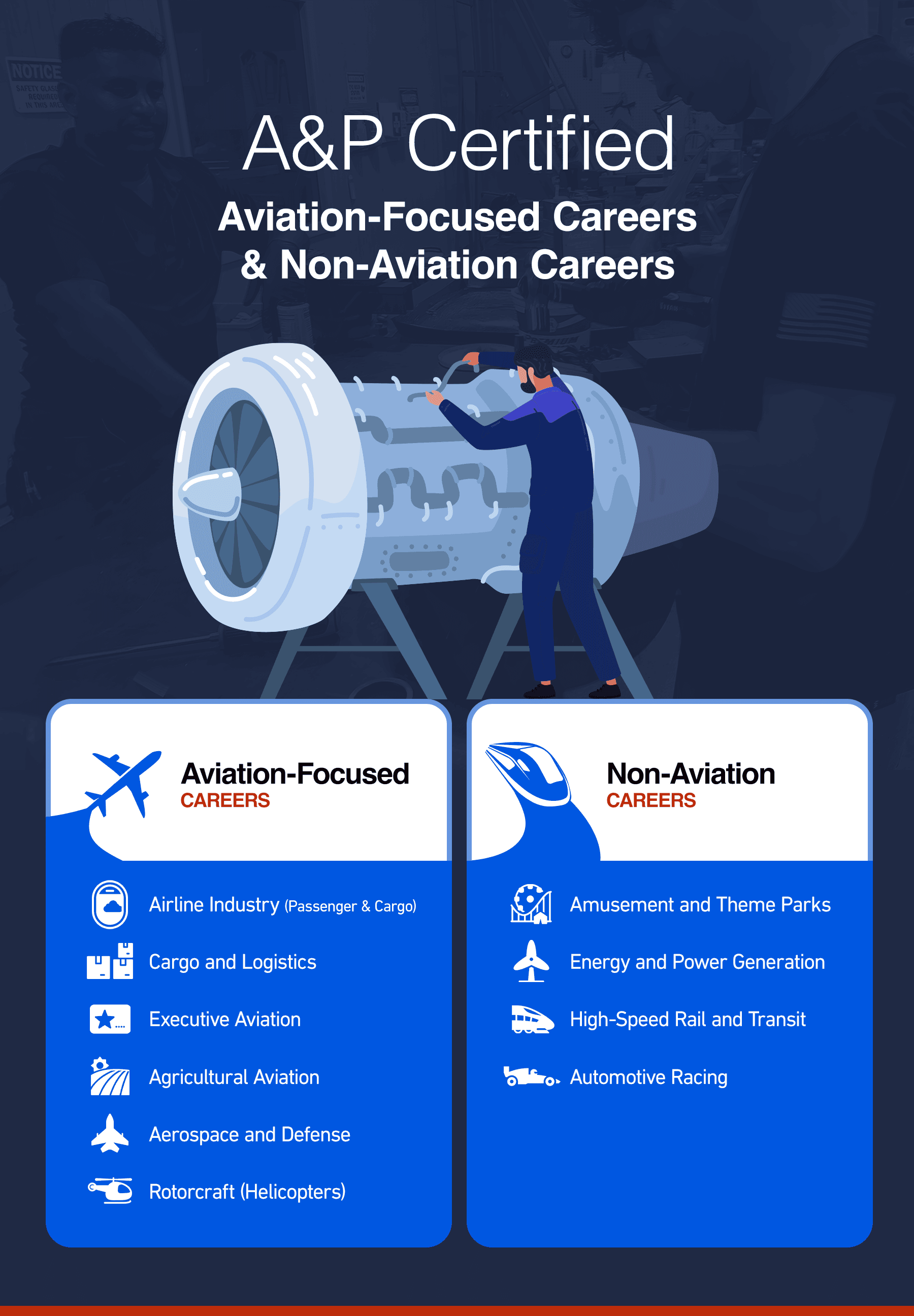
Aviation-focused careers: Commercial airlines, cargo and logistics, executive aviation, agricultural aviation, aerospace and defense, and rotorcraft.
Non-aviation careers: Amusement and theme parks, energy and power generation, high-speed rail and transit, and automotive racing.
Completing this certification training presents candidates with several new opportunities. As the world continues to embrace faster, more streamlined technologies, these career options may continue to expand.
Frequently Asked Questions
Having the right information can be the deciding factor in where and how you choose to study. As you consider an A&P certification study, you may have a few questions.
These are some of the most frequently asked questions about an A&P certification study:
What Job Titles in Aviation Can I Get With an A&P License?
Common job titles that A&P-qualified individuals can get with this license include aircraft maintenance technician, aircraft maintenance mechanic, airframe mechanic and powerplant mechanic. Other job titles include quality assurance or inspector, inspection authorization mechanic, avionics technician and line maintenance technician.
Can I Just Work on Cars With an A&P License?
Absolutely. An airframe and powerplant license isn't restricted to aviation. Ambitious people looking to work exclusively on cars can still benefit from this certification. It also broadens the potential jobs available to you, particularly in high-end, innovative automation brands and industries.
What Is the Typical Day of an Aircraft Mechanic?
Each day is different depending on the chosen area of career expertise. For example, an A&P technician may be required to conduct an inspection during the day. Other areas of aviation may include working at night to repair or inspect aircraft for early-morning takeoffs. Gaining experience is key to developing a strong skill set, so working unusual hours may be part of your learning process.
Is an A&P License Worth It if I Don't Want to Work for an Airline?
Yes. An A&P license provides a federal stamp of approval that opens the door to several career opportunities. The industrial transferability it offers helps you enter other respected industries. Core skills like technical expertise, problem-solving and adherence to safety can be taken many places. This certification also helps increase earning potential in future specialized roles.
Meet The Author:
John Detrick
John Detrick is the Chief Mechanic Instructor at A&P Mechanic Institute in Lakeland. John holds a Bachelor of Science degree in Aviation Science and a Master of Science degree in Aeronautics. John earned his A&P certificate in 1990 and has since worked in the aviation industry, building up a wealth of knowledge in aircraft maintenance.
Related Posts

A&P School
-
Sep 24, 2026
A&P School ROI: Is the Investment Worth It?
A&P school delivers a strong ROI, often with lower costs and faster earnings than a four-year degree. Get certified in 15 months. Learn more today.
John Detrick

A&P School
-
Sep 16, 2026
How Long Does A&P Certification Take?
A&P certification takes 18 to 24 months at most schools. Complete our accelerated program in just 15 months in Lakeland, FL. Contact us today.
John Detrick

Careers
-
Sep 11, 2026
Aircraft Maintenance Career Outlook
A&P mechanics earn competitive wages and enjoy lasting job security in a growing field with nationwide demand. Explore FAA-approved training programs now.
John Detrick