
Published:
Updated:
How to Become a Theme Park Technician
Theme park technicians keep the behind-the-scenes magic running at some of the world's most thrilling attractions. This career offers lucrative opportunities if you enjoy hands-on work, complex machinery and ensuring guest safety on roller coasters, rides, animatronics and robotics systems. However, it isn't always obvious what training and certifications will put you on a route to success.
This guide walks you through every step and reveals the single most valuable credential for launching a successful career in this field.
A Step-by-Step Guide to Launching Your Career
Breaking into this field is straightforward when you know how to proceed. Use this roadmap to plan your path from initial interest to employment, with each stage building the skills and credentials employers actively seek.
1. Build Your Foundational Mechanical Skills
Successful theme park technicians share several core aptitudes. Mechanical inclination is paramount. You should feel comfortable troubleshooting problems, working with your hands and paying close attention to small details. Theme park attractions operate in unconventional environments, from extreme heights to tight spaces, so physical comfort in these settings is essential.
Technicians are responsible for creating memorable visitor experiences by performing preventive checks and addressing issues before they affect operations. Every inspection and repair has tangible consequences for guest safety and satisfaction.
2. Meet the Core Educational Requirements
A high school diploma or GED is the baseline credential for most training programs and apprenticeships. Whether you're a career changer or a young adult starting out, this accessible entry point makes the field attainable.
Also, taking math, physics and vocational or shop classes in high school gives you a significant advantage. These subjects help you understand mechanical systems, electrical circuits and the physics governing how attractions operate.
3. Choose Your Advanced Training Path
Training for a theme park technician includes several options, from on-the-job learning to basic vocational certificates. However, the Federal Aviation Administration A&P certification is the benchmark for anyone who is serious about this career path.
Why does it matter? Aircraft maintenance operates under the highest safety and skill standards in any industry. The FAA holds aviation mechanics to rigorous requirements that exceed those of most other fields. Earning an A&P certification demonstrates your mastery of complex systems under the most stringent conditions.
The direct connection to theme parks is that modern roller coasters, attractions, animatronics and robotics systems use many of the same systems found in aircraft. Hydraulics control motion and braking, pneumatics move robotic components and animatronic figures, electrical systems run sensors and controls and motors drive mechanical functions. The A&P aircraft Powerplant course will give you hands-on familiarity with these. When you feel confident maintaining an aircraft engine, keeping a roller coaster shipshape becomes a natural application of the same skills.
An A&P-certified technician brings proven expertise that translates across industries, giving you access to a wide range of career opportunities — and leading theme park employers may immediately recognize these skills.
4. Gain Hands-On Experience
Hiring managers assess practical experience to separate successful candidates from those who don't make the cut. Through apprenticeships and internships, you'll work alongside veteran technicians and see how they apply their knowledge in real situations.
Many theme parks also offer structured training programs for new hires. Getting an entry-level position at a park, even as a ride operator, can be strategic. You'll build relationships with the maintenance team and position yourself for openings when they arise.
5. Master Industry Safety Standards
Safety comes first. Theme park technicians work under strict protocols that govern every aspect of ride maintenance and operation.
Organizations like the American Society for Testing and Materials International set industry technical standards. Their F24 Committee specifically addresses amusement ride design standards, creating the framework that ensures guest safety. As a technician, you'll perform daily inspections according to these protocols, documenting each check and addressing issues before the park opens.
What Does a Theme Park Technician Do Daily?
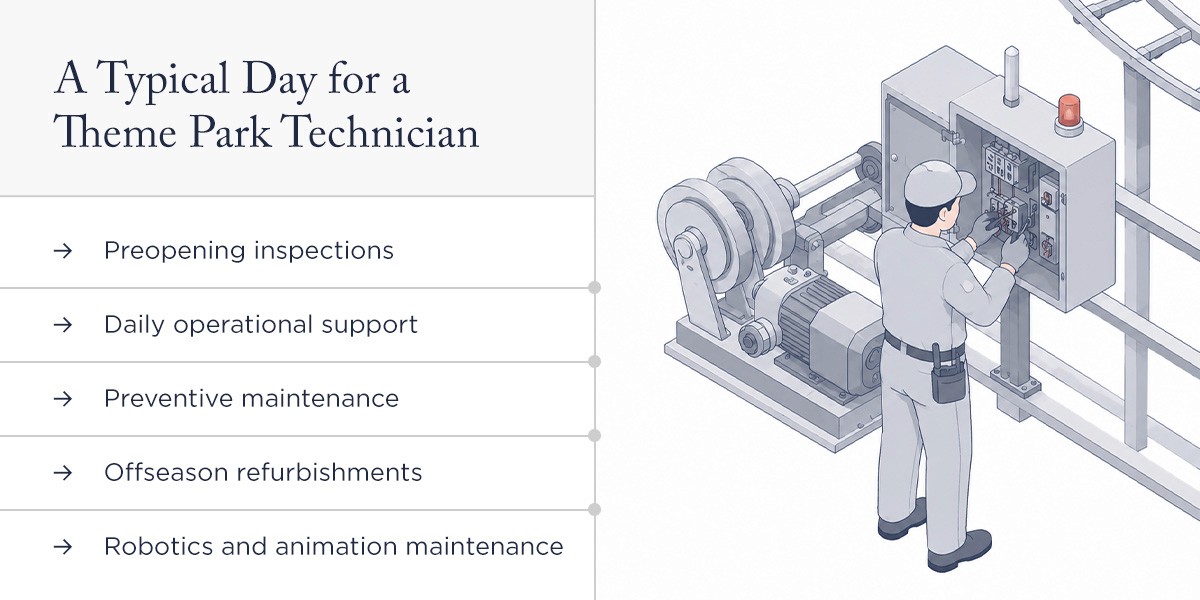
The daily reality of theme park maintenance follows a predictable but demanding cycle. Your work determines whether attractions operate safely and reliably.
Here's what a typical day might look like.
Preopening inspections: Arriving before the guests to complete safety checks on every ride system, testing controls and examining mechanical components.
Daily operational support: Responding quickly to issues that arise, troubleshooting problems and coordinating with operations staff to minimize downtime.
Preventive maintenance: Performing scheduled maintenance tasks, lubricating moving parts and replacing components before they fail.
Offseason refurbishments: Conducting comprehensive overhauls, upgrading systems and preparing attractions for the next operating season.
Robotics and animation maintenance: Troubleshooting animatronic figures and special effects systems, calibrating sensors and repairing control systems that bring characters and shows to life.
This rhythm defines theme park ride maintenance throughout the year. The work demands consistency and adaptability as you balance routine tasks with unexpected challenges.
Job Outlook and Salary Expectations
Financial stability matters when choosing a career path. Theme park technicians earn competitive salaries that reflect the specialized skills required for the job.
According to industry data, amusement park mechanics earn an average of $61,500 annually, with experienced professionals and those holding advanced certifications commanding higher wages. Technicians specializing in robotics and industrial electronics may command premium rates. Roller coaster technician salary levels vary based on location, experience and specialty. Ride mechanic salary figures follow similar patterns, but the field offers steady work with room for advancement.
Year-round theme parks constantly need qualified maintenance staff. The skills you develop in this sector will transfer across industries, from aviation to manufacturing to energy production.
Is This Career Path Right for You?
Every career comes with trade-offs. Understanding both sides helps you make an informed decision about whether this path fits your goals and lifestyle.
Consider these advantages.
Hands-on work: You'll work with complex machinery in an exciting environment, solving real engineering problems rather than sitting at a desk.
Pride in public safety: Every task you complete ensures guest safety, giving your work genuine meaning and importance.
Career stability: Qualified technicians remain in demand as theme parks continue expanding and maintaining their attractions.
Diverse opportunities: Your skills transfer to other industries beyond theme parks, including aviation, utilities and industrial maintenance.
You must also be realistic about the challenges inherent to this job.
Early-morning schedules: Most days start before sunrise to complete inspections before the park opens.
Weather exposure: You'll work outdoors in all conditions, from summer heat to winter cold.
Physical demands: The job requires comfort with heights, confined spaces and physically demanding tasks.
High-pressure situations: You'll need to diagnose and fix problems quickly when a ride goes down during peak hours.
Frequently Asked Questions
These insightful answers can help you plan your next move.
How Long Does It Take to Become a Theme Park Technician?
The timeline varies based on which path you choose. While some people learn on the job over several years, a structured certification program offers a faster route. The FAA A&P certification program prepares you for high-level roles in 15 to 22 months.
What Certifications Are Most Valuable?
Of all the certifications in the maintenance field, the FAA A&P certification is the gold standard. This credential proves you've mastered complex systems under aviation's rigorous standards. Employers across industries immediately recognize its value.
Do I Need a College Degree?
Not necessarily. Theme park maintenance departments prioritize hands-on skills and specialized technical training over academic degrees. Earning the A&P certification will give you the background knowledge you need without spending four years in a traditional college program.
How Much Does It Cost to Become a Theme Park Technician?
A&P Mechanic Institute offers an affordable path compared to four-year degrees, with a high return on investment. We offer tuition and financing options. Contact our team to discuss costs and find the financial solution that works for you.
Move Your Career Forward at A&P Mechanic Institute
The path to becoming a theme park technician is more open than you think. The FAA A&P certification is the industry-leading credential that opens doors across multiple industries, including the fascinating world of theme parks.
A&P Mechanic Institute offers the hands-on training you need to get there. You're not just a number here. Our small class sizes, experienced instructors and personalized support ensure you get the attention you deserve.
We invite you to explore our class schedules to find day or evening options and start your application today. If you have questions, call us today to get immediate answers.
Meet The Author:
John Detrick
John Detrick is the Chief Mechanic Instructor at A&P Mechanic Institute in Lakeland. John holds a Bachelor of Science degree in Aviation Science and a Master of Science degree in Aeronautics. John earned his A&P certificate in 1990 and has since worked in the aviation industry, building up a wealth of knowledge in aircraft maintenance.
Related Posts

A&P School
-
Sep 24, 2026
A&P School ROI: Is the Investment Worth It?
A&P school delivers a strong ROI, often with lower costs and faster earnings than a four-year degree. Get certified in 15 months. Learn more today.
John Detrick

A&P School
-
Sep 16, 2026
How Long Does A&P Certification Take?
A&P certification takes 18 to 24 months at most schools. Complete our accelerated program in just 15 months in Lakeland, FL. Contact us today.
John Detrick

Careers
-
Sep 11, 2026
Aircraft Maintenance Career Outlook
A&P mechanics earn competitive wages and enjoy lasting job security in a growing field with nationwide demand. Explore FAA-approved training programs now.
John Detrick