Published:
Updated:
Complete Guide to the Aircraft Mechanic A&P Exam
The path to becoming an aircraft mechanic starts with one major milestone — passing the Airframe and Powerplant (A&P) license test. If you're ready to launch a career in aviation maintenance, you have questions about what the exam actually involves, what it takes to qualify and how to prepare for success.
This guide gives you a complete roadmap to the A&P certification process. You'll learn what the exam covers, how to meet eligibility requirements, what to expect on test day and how to move forward after you pass. Fresh out of high school or changing careers — this is your clear path to aviation maintenance certification and a rewarding future in the field.
What Is the A&P Exam?
The Federal Aviation Administration (FAA) A&P test is a federal assessment required for professional certification. It validates your knowledge and skills in maintaining and repairing aircraft that meet federal standards. The assessment covers three knowledge areas:
General
Airframe
Powerplant
To earn your A&P certificate, you'll complete written knowledge tests for each area, followed by a combined oral and practical evaluation.
Airframe vs. Powerplant Explained
The A&P certificate has two separate ratings that address different aircraft systems. The airframe maintenance course rating focuses on structural components and systems:
Fuselage
Wings
Landing gear
Hydraulics
Electrical systems
Falling under the aircraft powerplant course rating:
Engines
Propellers
Related powerplant systems
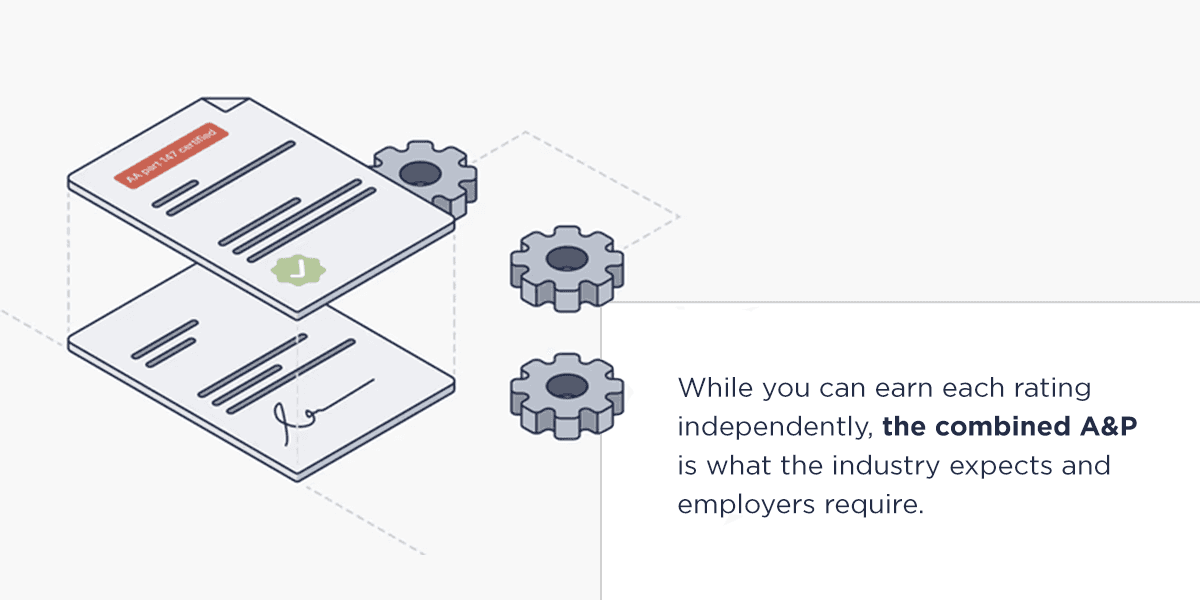
While you can earn each rating independently, the combined A&P is what the industry expects and employers require.
Why Get A&P Certified?
A&P certification opens doors to a career field with strong earning potential. In 2024, aircraft mechanics earned a median wage of $79,140. Airlines, repair stations and maintenance facilities continue to seek qualified technicians. Many mechanics also find opportunities at theme parks, in utilities and energy sectors or with manufacturing companies.
Now that you understand the value of certification, let's look at what it takes to qualify for testing.
A&P Exam Requirements and Eligibility
Before you can sit for the aviation maintenance technician (AMT) assessment, you need to meet the eligibility requirements set by federal regulations.
Age and Language Requirements
Federal regulations outlined in 14 CFR Part 65 establish baseline requirements:
You must be at least 18 years old
You need to read, write, speak and understand English
Two Pathways to Eligibility
You can qualify through a school that offers FAA Part 147 training, completing a structured program that typically spans 15 to 23 months. This approach includes classroom instruction and hands-on training across general, airframe and powerplant systems.
Alternatively, you can document practical work experience — at least 18 months for a single rating or 30 months for airframe and powerplant. For recent high school graduates, the school path provides a clear start without needing years of prior experience.
Required Documentation
To access testing, you'll need FAA Form 8610-2, officially titled the Airman Certificate and/or Rating Application. For those qualifying through work experience, an FAA inspector will review your documentation and approve your eligibility.
Understanding the Three FAA A&P Tests
The FAA requires every candidate to pass four separate assessments — three written knowledge tests and one combined oral and practical evaluation. Each component tests different aspects of your aviation maintenance expertise. You can find complete details about test requirements on the FAA website.
Written Knowledge Tests Overview
The written assessments are multiple-choice and administered on a computer, covering:
Regulations
Maintenance procedures
Materials
Tools
Technical knowledge specific to each rating area
They are divided into three tests — general, airframe and powerplant knowledge:
Test | Questions | Time Limit | Passing Score |
|---|---|---|---|
General | 60 | 2 hours | 70% |
Airframe | 100 | 2 hours | 70% |
Powerplant | 100 | 2 hours | 70% |
Oral and Practical Exams Explained
After passing all three written assessments, you become eligible for the oral and practical evaluation. A Designated Mechanic Examiner (DME) — an FAA-authorized instructor — conducts this in-person assessment of your verbal knowledge and hands-on capabilities. During the oral portion, you'll respond to questions about maintenance procedures, regulations and technical concepts.
The practical segment requires you to demonstrate actual maintenance tasks like safety wiring, sheet metal repair or engine inspections.
Can You Take Tests in Any Order?
While federal regulations allow you to take the written assessments in any sequence, the standard approach follows a logical progression: General first, then airframe, then powerplant. This makes sense because general content establishes foundational knowledge that applies to both specialized ratings. One requirement exists — you must complete all three written assessments before scheduling your oral and practical evaluation. Written test results remain valid for 24 months.
Taking the A&P License Test
Once you've met eligibility requirements and prepared for testing, the logistics become your focus — scheduling appointments, understanding costs and knowing what to bring.
How Much Does the A&P Exam Cost?
PSI sets written test fees as the official testing provider. The oral and practical evaluation fee varies depending on which DME you choose.
Many schools can advise you on financing options, while the FAA provides no-cost testing if you qualify under the Memorandum of Agreement (MOA) between the FAA and the Joint Service Aviation Maintenance Technician Certification Council (JSAMTCC).
Finding PSI Test Centers
PSI administers the written knowledge assessments at authorized testing centers nationwide. You can locate PSI test centers through their website. Some aviation maintenance schools hold certification as PSI testing centers, which means enrolled students can complete written assessments on campus.
How to Schedule Your Exams
Scheduling follows a straightforward process:
Get your FAA tracking number (FTN) when you register through the FAA's IACRA website.
Book your written assessments using your FTN to schedule appointments through the PSI website.
Arrange your oral and practical evaluation, then, after completing your written tests, contact a DME to schedule your final assessment.
What to Bring on Test Day
For written assessments, you'll need your signed authorization form and a government-issued photo ID. Your authorization form is either your signed FAA Form 8610-2 or your graduation certificate from a Part 147 training school.
What Happens if You Fail?
A failed test doesn't end your A&P certification journey. Federal regulations have clear retesting policies:
Written exam retesting: You'll need a statement from an instructor certifying that you've received additional instruction in the areas you missed. You can retake the test after 30 days.
Failed oral and practical portions: You only need to retake the specific sections you didn't pass.
Targeted preparation: Your knowledge test report will tell you exactly which subject areas you missed.
The pass rates for 2025 show that many candidates succeed with preparation:
General achieved 69.59% pass rate
Airframe reached 74.01%
Powerplant came in at 63.04%
After You Pass
Successfully completing your assessments marks a major accomplishment and the official start of your career as a certified aviation maintenance technician.
Getting Your A&P Certificate
Once you finish your oral and practical evaluation, the DME issues a temporary A&P certificate on the spot. This temporary certificate authorizes you to begin working immediately. Your official FAA certificate typically arrives by mail within a few weeks.
Job Opportunities
There are many career opportunities available with an A&P certification. The aviation industry actively recruits qualified A&P mechanics to work for:
Major airlines
Regional carriers
Repair stations
Corporate aviation departments
Aerospace manufacturers
Many schools maintain career services and employer partnerships to help you connect with opportunities.
Continuing Education Requirements
Your certificate doesn't expire, but you need to stay active in your field. Federal regulations require that you work as a mechanic for at least six months out of every 24-month period to maintain your privileges.
Get Started With A&P Mechanic Institute
Passing the A&P exam is just the beginning of your aviation maintenance career. A&P Mechanic Institute offers a faster, more affordable path to certification with FAA-approved training in general, airframe maintenance systems and powerplant maintenance systems. You'll get hands-on experience with day and night class options, learn from experienced instructors at our school and graduate with guaranteed interviews at our partner flight schools.
If you're ready to start your journey, our admissions team is here to answer your questions and help you take the next step. Contact us today to learn more about our programs and what an A&P certificate can do for your career.
Meet The Author:
John Detrick
John Detrick is the Chief Mechanic Instructor at A&P Mechanic Institute in Lakeland. John holds a Bachelor of Science degree in Aviation Science and a Master of Science degree in Aeronautics. John earned his A&P certificate in 1990 and has since worked in the aviation industry, building up a wealth of knowledge in aircraft maintenance.
Related Posts

A&P School
-
Sep 24, 2026
A&P School ROI: Is the Investment Worth It?
A&P school delivers a strong ROI, often with lower costs and faster earnings than a four-year degree. Get certified in 15 months. Learn more today.
John Detrick

A&P School
-
Sep 16, 2026
How Long Does A&P Certification Take?
A&P certification takes 18 to 24 months at most schools. Complete our accelerated program in just 15 months in Lakeland, FL. Contact us today.
John Detrick

Careers
-
Sep 11, 2026
Aircraft Maintenance Career Outlook
A&P mechanics earn competitive wages and enjoy lasting job security in a growing field with nationwide demand. Explore FAA-approved training programs now.
John Detrick